September 9, 2025
Save Time and Materials – Solve in 3D
WSP shares insights into 2D limitations – and concrete solutions using Optum.
With over 70,000 employees worldwide and projects in more than 40 countries, WSP is one of the world’s leading engineering consultancy firms. In Denmark, WSP works across infrastructure, construction, climate adaptation, and energy.
At WSP Ports & Marine, we spoke with Jesper Hauge Larsen and Daniel Virgilsen – engineering graduate and chief advisor, respectively – about how they work with geotechnics in Optum, and the challenges and pitfalls they’ve encountered with 2D analyses.
Together, we’ve taken a deep dive into a circular excavation pit, where inflowing groundwater posed a challenge. We explored ring effects, where 2D fell short, and investigated how 3D stress distribution calculations can save both time and materials.
Circular Excavation Pit Required 3D
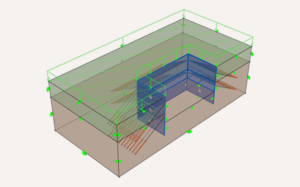
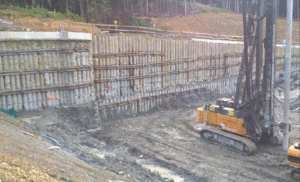
When constructing a round secant pile excavation pit, WSP faced a well-known geotechnical challenge: permeable materials and inflowing groundwater. At the same time, the geometry meant that a 2D model couldn’t provide an optimal calculation.
“We had issues with inflowing groundwater because the soil included permeable sand layers. The solution was to cast a thick concrete base plug to stop the inflow,” explains Jesper.
The circular geometry of the pit created a natural ring effect – an advantageous load distribution where the pressure is evenly spread around the circumference, thereby stabilising the wall from within

“When you have a ring effect, the wall can actually be made thinner or the internal bracing reduced – thanks to the hoop stresses,” Jesper explains.
But ring effects cannot be documented in 2D, because in 2D the wall is modelled as a flat plane. This underestimates the actual strength of the structure and results in an incorrect and overly conservative calculation.

That’s why a 3D model was necessary to determine bending moments and hoop stresses. And because the pit was later to be broken through for micro tunnelling, we ended up reinforcing the secant piles.

Jesper Hauge Larsen
Engineering Graduate, WSP
3D Calculations Optimised Material Use
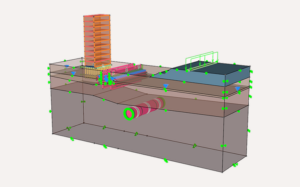
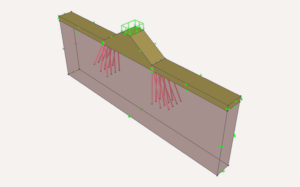
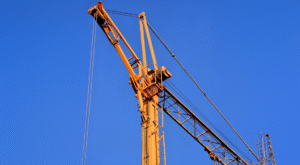
In 2019, WSP was tasked with designing the back lands for the expansion of the Port of Frederikshavn. The new harbour area – 180,000 m² – needed to be dimensioned to support a crawler crane. Here, it became clear that a 2D model couldn’t provide a realistic picture of how the load was distributed through the crushed rock bearing layer.
“Due to the crawler tracks, the crane’s load is distributed through the belts and spreads diagonally into the ground – resulting in a three-dimensional distribution of pressure. We quickly realised that 2D was too conservative for modelling this accurately, since it only provides vertical slices, and the load is idealised as either a line or point load,” Daniel explains.
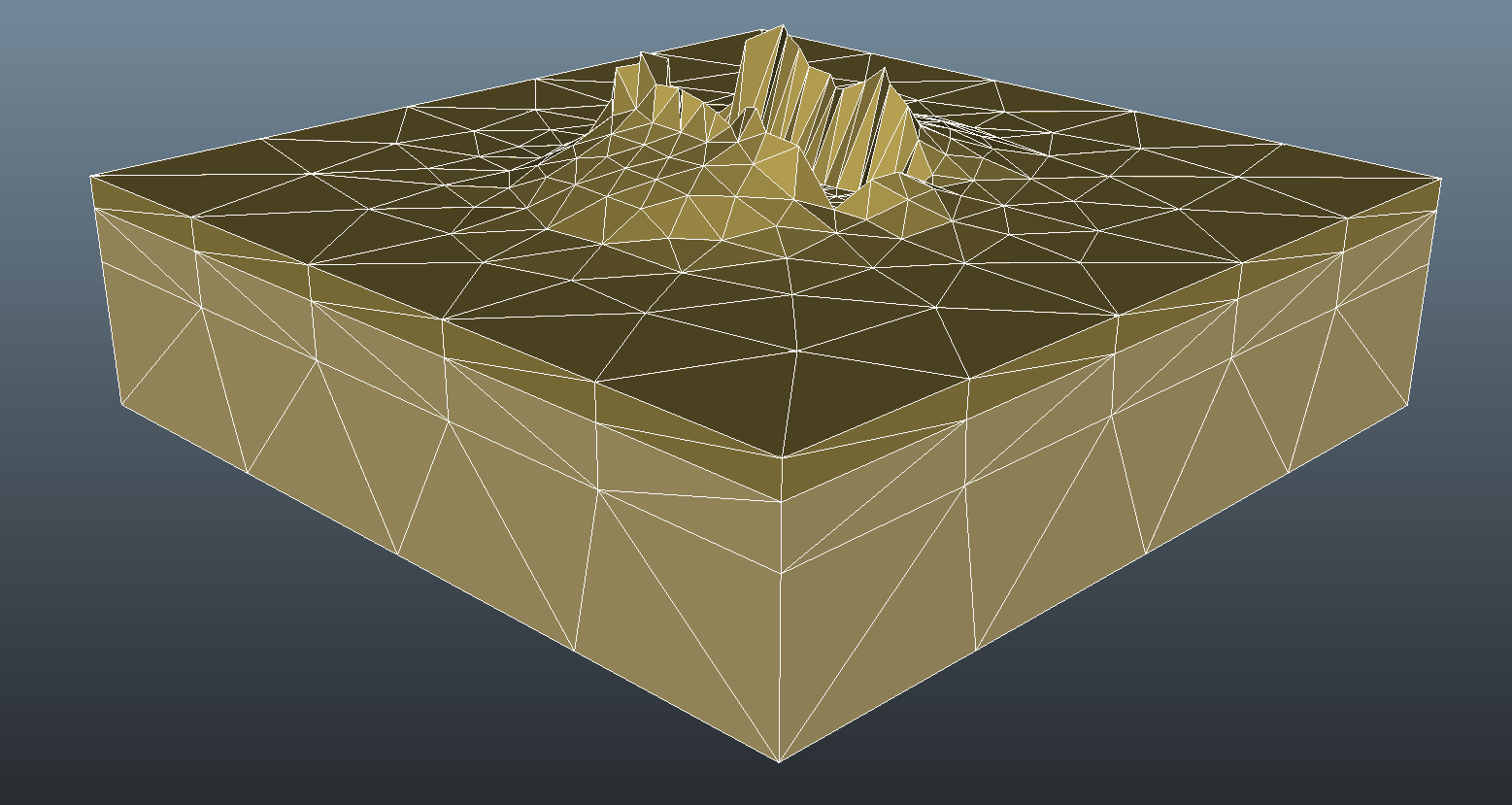
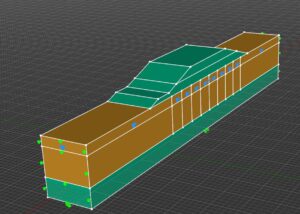
Using a 3D model in OPTUM G3, it became possible to get an accurate representation of the stress distribution – and when compared to the 2D results, the model revealed significant optimisation potential.
“On an area of that size, differences of 10, 20, or 30 centimetres in layer thickness mean a great deal in terms of material usage. The 3D model enabled us to find an optimal solution, where we could significantly reduce the amount of crushed rock – without compromising safety,” says Daniel.
He adds:
Many of the geotechnical tasks we solve at WSP can be effectively modelled in 2D – such as slope stability analyses, excavation profiles, and retaining walls. But examples like this show how important it is to consider the third dimension. In the end, it can mean major savings in both time and materials.
Daniel Virgilsen
Chief Advisor, WSP
Considering the industry’s strong focus on sustainability, optimising material use not only leads to lower costs and shorter construction time – but also to a reduced CO₂ footprint. With 3D calculations, engineers gain a powerful tool to combine technical precision with more sustainable solutions.
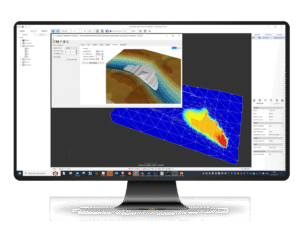
Work in both 2D and 3D in OPTUM GX

Spæncom Slashes Design Time with Automation in OPTUM CS
January 6, 2026
Since the first Olsen Gang film in 1968, Vridsløselille in Albertslund has been a place of ambitious plans. Back then, Egon Olsen sat behind the prison walls, devising his supposedly...
Automation
Concrete
Numerical modelling
OPTUM CS
Python

Sweco Saves Time with Optum
November 3, 2025
As one of Europe’s largest architecture and engineering consultancies, Sweco’s 22,000 specialists handle complex infrastructure projects across the continent. With Optum, their engineers can calculate faster – freeing up more...
Foundations
Geotechnical
Infrastructure
load transfer
Numerical modelling
OPTUM G2
Slope stability
WSP: When Soil Meets Concrete
September 9, 2025
WSP uses Optum to model the complex interaction between soil and concrete — ensuring safe, realistic designs for deep excavations and stormwater basins....
Deformation
Excavations
Geotechnical
Numerical modelling
Retaining wall
Soil-structure interaction