Beyond Factor of Safety:

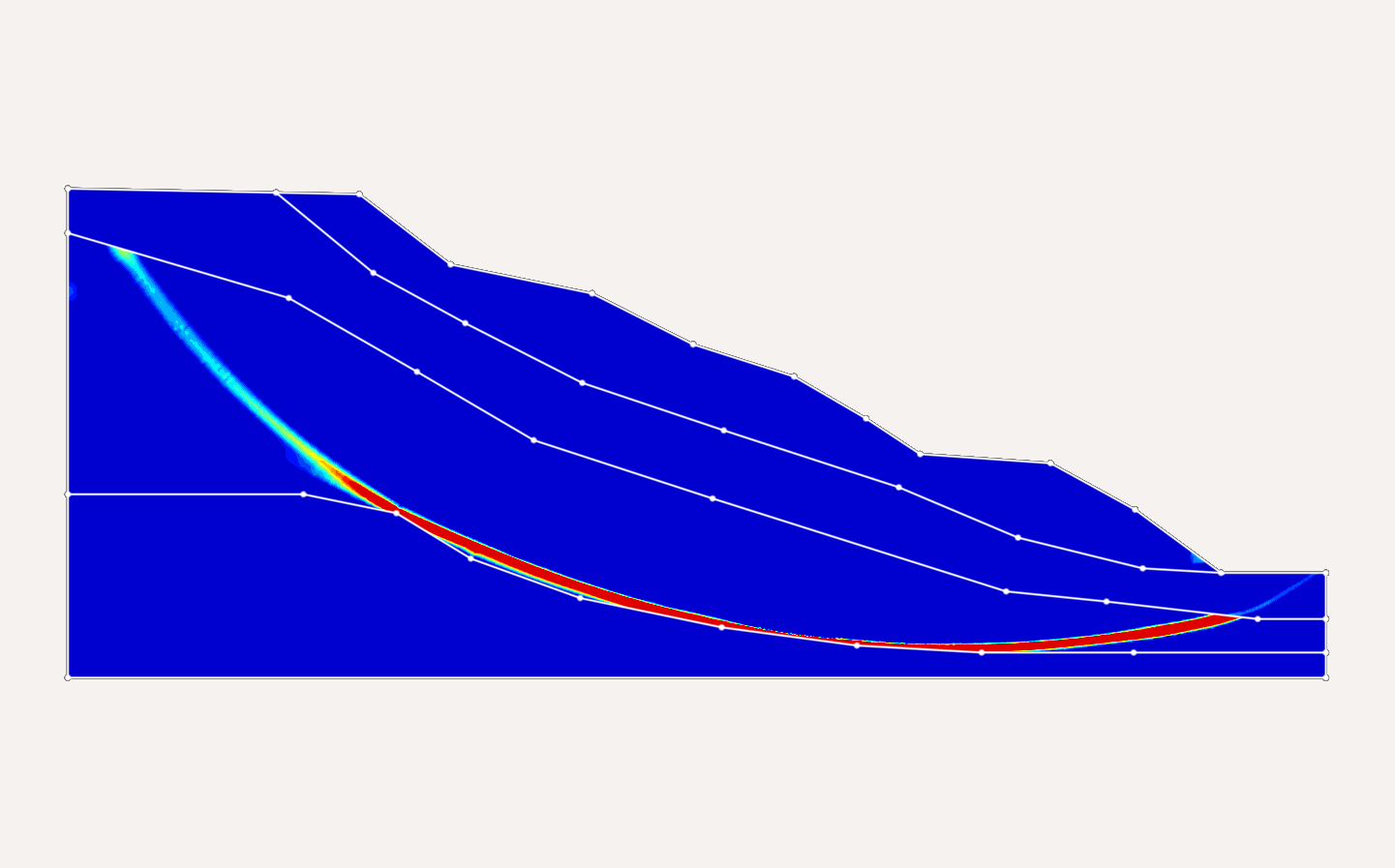
Determination of stability of slopes have been a major challenge in geotechnical engineering. Slopes that pass through the rigours analysis often fail due to several on-site uncertainties making it a challenge for geotechnical engineers.
Slope stability analysis has traditionally been performed using deterministic methods that produce a single Factor of Safety (FoS). Whether using limit equilibrium methods, finite element strength reduction techniques, or finite element limit analysis, engineers typically compare the calculated FoS against a prescribed design criterion and classify the slope as either stable or unstable.
While this approach remains widely accepted, it does not explicitly account for one of the most important characteristics of geotechnical engineering: uncertainty.
Soil properties vary spatially, groundwater conditions fluctuate over time, and subsurface investigations provide only a limited representation of the ground. As a result, two slopes with the same calculated Factor of Safety may exhibit significantly different levels of risk.
Reliability analysis addresses this limitation by quantifying the probability of failure rather than relying solely on a deterministic safety factor.
The Limitations of Deterministic Slope Stability Analysis
Traditional slope stability analyses assume that soil parameters such as cohesion, friction angle, and unit weight are known precisely. In reality, these parameters are derived from limited laboratory and field testing and inherently contain uncertainty.
A deterministic analysis may indicate a factor of safety (FoS) of 1.30.
However, this single value provides no information regarding:
- Variability of soil properties
- Confidence in the input parameters
- Probability of slope failure
- Influence of geological uncertainty
Consequently, a slope with a FoS of 1.30 may have a negligible probability of failure, while another slope with the same FoS may represent a substantial risk.
Reliability-Based Slope Stability
Traditional slope stability analyses assume that soil parameters such as cohesion, friction angle, and unit weight are known precisely. In reality, these parameters are derived from limited laboratory and field testing and inherently contain uncertainty.
Reliability analysis treats soil parameters as random variables rather than fixed values.
Typical random variables include:
- Effective cohesion (c')
- Effective friction angle (φ')
- Unit weight (γ)
- Permeability
- Groundwater level
- External loading conditions
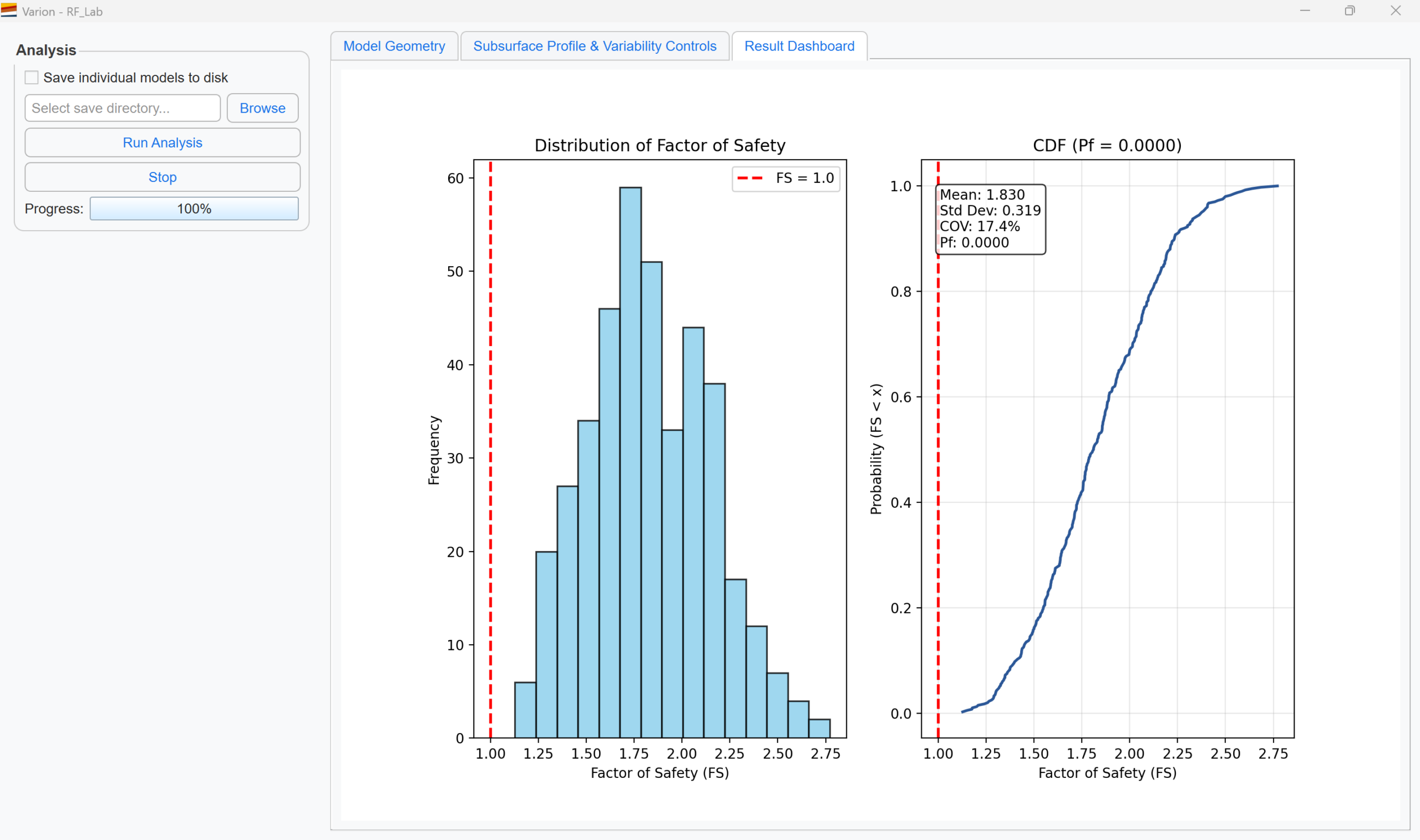
The objective is to determine Probability of Failure (Pf)
Pf = P (FoS < 1.0)
or equivalently Reliability Index (β) which represents the statistical distance between the expected system performance and failure. Rather than asking "What is the Factor of Safety?", reliability analysis asks: "How likely is failure?". This provides a more meaningful basis for risk-informed decision making.
Why Reliability Matters in Geotechnical Engineering
Reliability analysis is particularly valuable because geotechnical designs are often governed by uncertainty rather than deterministic strength calculations.
Applications include:
- Natural slopes
- Highway embankments
- Open-pit mine slopes
- Earth dams
- Tailings storage facilities
- Excavations and retaining structures
In many cases, economic optimization can only be achieved by understanding the acceptable level of risk rather than relying on conservative deterministic factors of safety.
Reliability Analysis Using OPTUM GX
OPTUM GX is uniquely positioned for reliability-based slope assessment because of its finite element limit analysis framework.
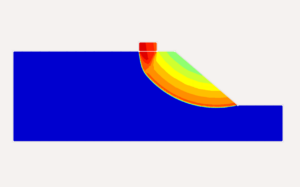
Unlike conventional strength reduction methods, OPTUM GX directly computes collapse loads and failure mechanisms using rigorous upper and lower bound formulations.
This provides several advantages when performing large numbers of simulations.
Fast Collapse Load Calculations
Reliability analysis typically requires hundreds or thousands of simulations.
The efficiency of finite element limit analysis allows engineers to perform large Monte Carlo studies significantly faster than traditional nonlinear finite element approaches.
Rigorous Failure Mechanisms
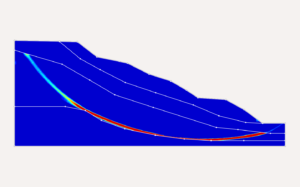
Every realization produces a physically meaningful collapse mechanism.
This allows engineers not only to quantify the probability of failure but also to investigate how failure mechanisms evolve as soil properties vary.
Automation through Python Scripting
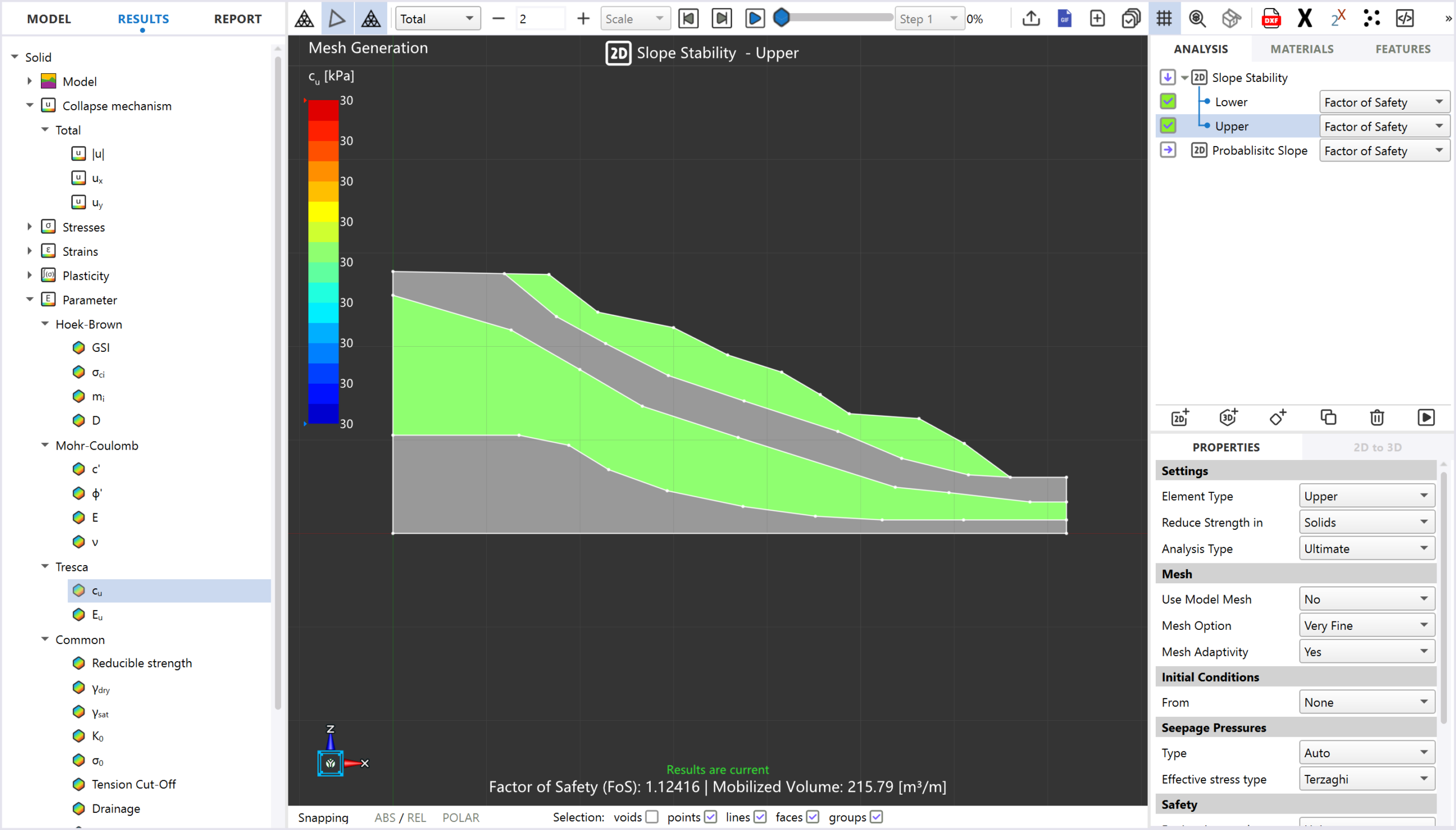
OPTUM GX provides scripting capabilities that can be leveraged to automate probabilistic studies.
A typical workflow involves:
- Generate random soil properties.
- Update material parameters automatically.
- Execute limit analysis.
- Store collapse load or FoS.
- Repeat for hundreds or thousands of realizations.
The resulting dataset can be used to determine:
- Mean FoS
- Standard deviation
- Probability of failure
- Reliability index
Moving Beyond Monte Carlo: Spatial Variability
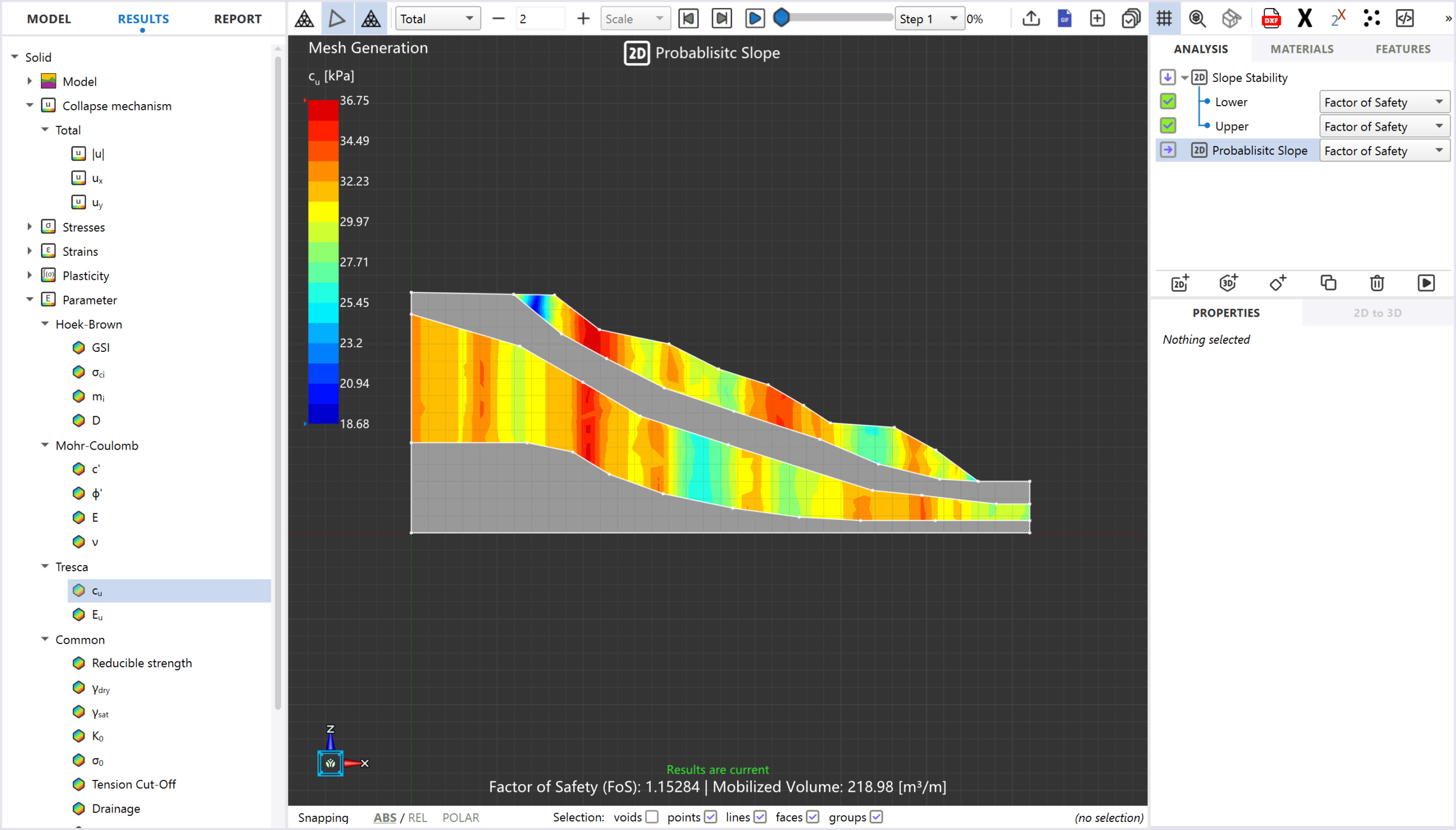
One of the most exciting developments in geotechnical reliability analysis is the use of random fields. Traditional Monte Carlo simulations assume that soil properties remain uniform throughout the slope. In reality, however, soil strength varies from one location to another.
Random field methods model parameters such as effective cohesion (c') and effective friction angle (φ') as spatially varying and correlated properties. This enables engineers to investigate:
- Scale of fluctuation effects
- Weak zones within slopes
- Spatial uncertainty
- More realistic failure mechanisms
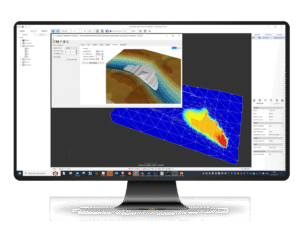
OPTUM GX streamlines this process through automation, Python scripting, adaptive meshing, and efficient limit analysis, making it possible to perform the large number of simulations required for reliability studies. The Random Field Plugin further enables engineers to introduce spatial variability directly into numerical models for slopes and foundations, helping identify weak zones, investigate more realistic failure mechanisms, and quantify the effect of soil variability on performance and risk.
Reliability-Based Design Optimization
Another emerging application is Reliability-Based Design Optimization (RBDO). Rather than designing to a target FoS, engineers can optimize geometry while maintaining an acceptable reliability level.
For example:
- Maximize slope angle
- Minimize excavation support costs
- Maintain a target probability of failure
This approach is becoming increasingly important in mining, transportation infrastructure, and large earthworks projects where economic efficiency and risk management must be balanced.
The Future of Slope Stability Assessment
The industry is gradually moving away from purely deterministic assessments toward risk-informed design methodologies.
Future workflows are expected to combine:
- Finite Element Limit Analysis
- Random Field Modeling
- Monte Carlo Simulation
- Reliability Analysis
- Machine Learning Surrogate Models
Within this framework, OPTUM GX provides a powerful platform for evaluating not only whether a slope is stable, but also how confident engineers can be in that assessment.
Conclusion
Factor of Safety remains an important design metric, but it does not quantify uncertainty or the probability of failure.
Reliability analysis extends the assessment by accounting for variability in soil properties, groundwater conditions, and other uncertain parameters. Using Finite Element Limit Analysis, adaptive meshing, Python-based automation, and random field modelling, OPTUM GX enables engineers to evaluate both failure probability and governing failure mechanisms efficiently.
The key question is no longer simply:
Is the slope stable?
It is:
How likely is it to fail, which uncertainties control the result, and what level of risk is acceptable?
OPTUM GX provides the numerical framework needed to answer these questions and support safer, more transparent, and more efficient design decisions.


Developed for engineers
Backed by performance
Download your free trial of OPTUM GX geotechnical software. No credit card required.
Just fill out a short form and start modelling real-world designs — not assumptions.
Download Free Trial
Frequently ASked Questions
Can’t find what you’re looking for? Contact us here.

Designing and Analyzing Foundations on Hilly Slopes
October 7, 2026
Determination of stability of slopes have been a major challenge Foundations built on or near hilly terrain do not behave like foundations on flat ground. The absence of confining soil...
Geotechnical
OPTUM GX
Advanced Slope Stability Assessment through Reliability Analysis in OPTUM GX
August 4, 2026
Determination of stability of slopes have been a major challenge in geotechnical engineering. Slopes that pass through the rigours analysis often fail due to several on-site uncertainties making it a...
Geotechnical
OPTUM GX
What is Finite Element Analysis?
February 3, 2026
Finite element analysis (FEA) is a numerical method that breaks a complex structure into many small “elements” to predict how it responds to loads, deformation, temperature changes and other physical...
FEA
Finite element analysis
Geotechnical
OPTUM GX